Climate impact modelling on the built heritage affected by alteration processes caused by salt crystallisation
UAL Universidad de Alicante Spain
PhD enrolment : UAL
Supervisor: David Benavente
Co-supervisor: Tim De Kock - UAN
Start date September 2026
Duration (in months) 36
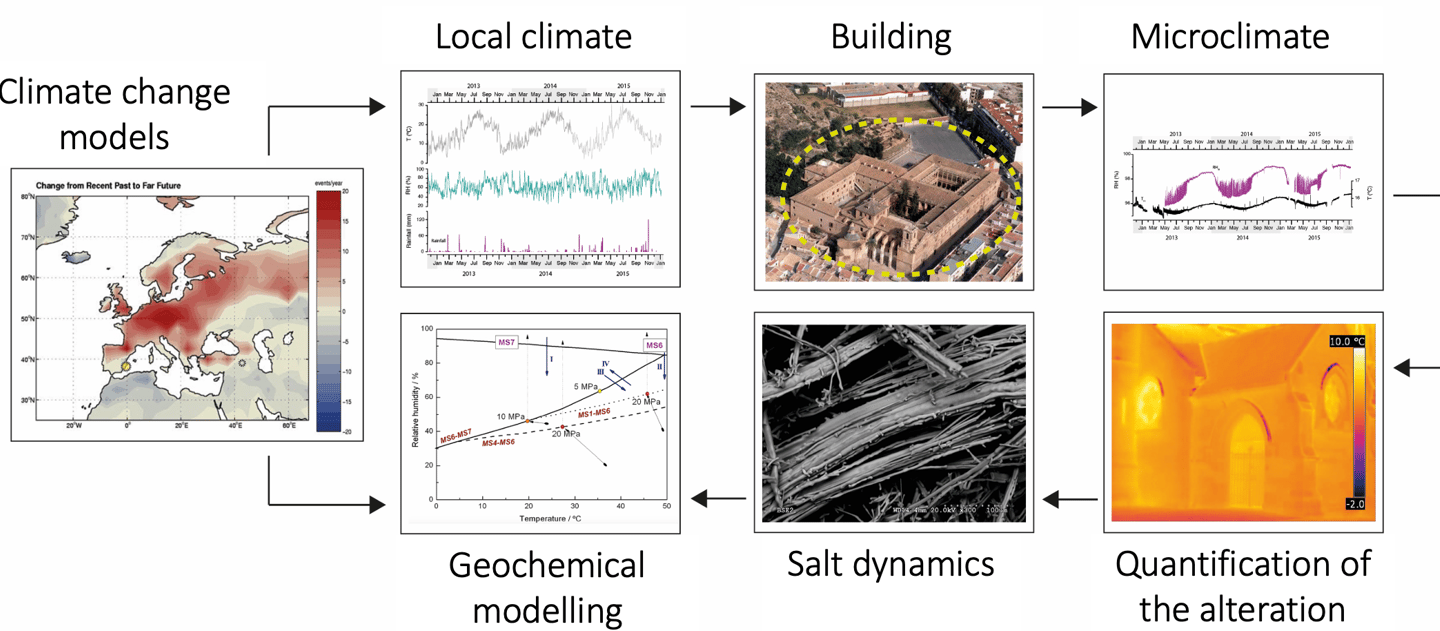
Objectives: This project aims to develop innovative tools, strategies, and guidelines that mitigate the detrimental effects environmental factors, ensuring the long-term preservation of our valuable cultural heritage. It is expected to achieve the following scientific impacts: (i) Parametrization of changes in the microclimate through the evaluation of different future scenarios of climate change; (ii) Development of a novel methodology enabling salt crystallisation modelling and simulation within building materials by altering thermohygrometric conditions; (ii) Conducting data and time series analyses of climatic and microclimatic temporal patterns to understand the relationship between thermo-hygrometric conditions and the deterioration of historic buildings. The definition of proxies for alterations caused by climatic events in the past will be integrated into a global predictive model that addresses stone alteration due to salt crystallisation induced by seasonal meteorological fluctuations or medium- to long-term climate changes using climate change projections.
Expected Results: The results of the project will be technologically transferred in the development of: (i) a computer program, based on the PHREEQC code, for the geochemical modelling of salt depletion due to changes in the thermohygrometric conditions; (ii) a specific computer program for the wavelet analysis of the microenvironmental and climatic data set for its study and characterization in monuments.
Planned secondment(s): -CY: B.Menendez, M12,4 weeks, experimental work -CNR: A. Bonazza, M24, 4 weeks, risk assessment. UAN/KIKIRPA: T. De Kock/S. Godts, M26, Salt crystallisation modelling
Réseau
contact@charm-project.eu
© 2025. All rights reserved.